Implant Grade Titanium: Piercing Materials and Sizes
Compare implant grade titanium, Washington starter-jewelry rules, 16g vs 18g, downsizing, and when to change piercing jewelry.
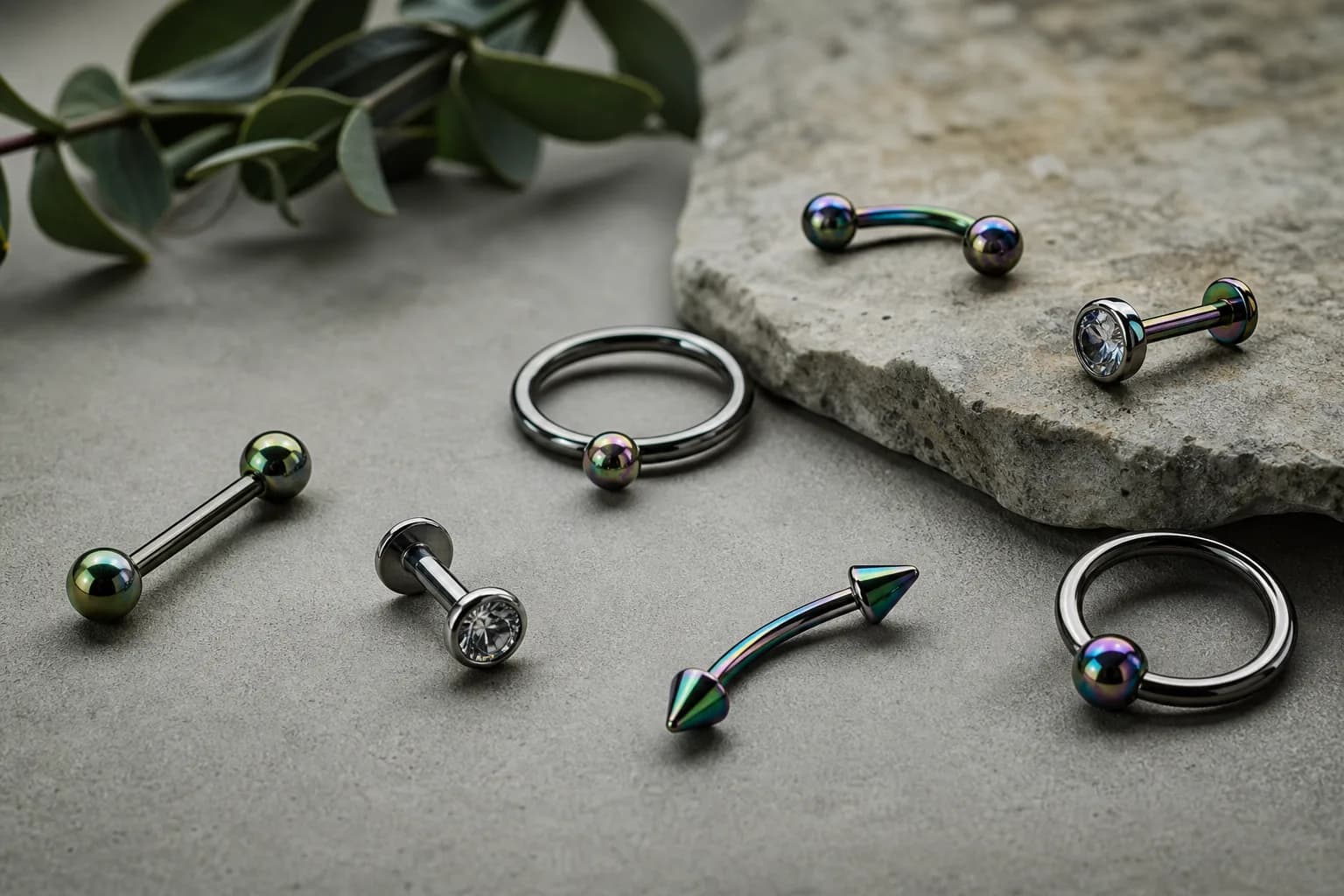
AI-generated illustration
Key takeaways
- ASTM F136 specifies a titanium alloy for surgical implants; ask which material specification your jewelry meets.
- APP says mill certificates document a metal grade, but the paperwork cannot show that a particular piece came from the documented batch.
- APP’s rounded measurements list 16g as 1.2 mm and 18g as 1.0 mm, so 16g is thicker.
- Downsizing means replacing initial jewelry with a shorter post after swelling subsides, with a piercer managing the change.
- ASTM F138 stainless steel contains nickel, which AAD identifies as a common cause of allergic contact dermatitis.
Choose implant grade titanium by its documented material specification—not by a generic “titanium” label—and ask your piercer to confirm the finished jewelry’s material, construction, and fit. Treat the product name as the starting point for questions, not the whole answer.
For a Washington jewelry appointment, separate the decisions: which material to use, what dimensions to buy, and whether the appointment is for initial placement, downsizing, or a change after healing. Bring those questions to your piercer before ordering a replacement based only on its appearance or gauge.
What does implant grade titanium actually mean?
Look for a documented material specification. ASTM F136 specifies wrought titanium-6aluminum-4vanadium ELI alloy for surgical implants and addresses chemical, mechanical, and metallurgical requirements. “ELI” means extra-low interstitial (ASTM F136). A listing that says only “titanium” does not identify that specification.
There is also a distinction between documenting the metal and verifying a finished piece. The Association of Professional Piercers (APP) says mill test certificates document a metal grade and its ASTM or ISO designation, but it is not possible to know from the paper whether a particular piece came from that batch. Documentation does suggest that a piercer buys from reputable sources (APP initial-jewelry guidance).
Ask how the manufacturer connects the jewelry being sold to the material described in its records.
What should you ask to verify the material?
Use these purchasing questions with your piercer or seller:
- Who manufactured this piece?
- Which exact material specification does the manufacturer claim?
- What documentation supports that claim?
- How does the manufacturer connect this finished jewelry to the documented material?
These questions help you evaluate the claim; they are not a guarantee that a piece is suitable for your piercing.
F136 is not the only titanium specification in APP’s initial-jewelry guidance. APP also lists ASTM F1295, ISO 5832-3, and commercially pure titanium compliant with ASTM F67 (APP titanium guidance). Ask for the exact designation rather than assuming every documented titanium option must carry the same one.
What does Washington require for initial piercing jewelry?
Washington’s legal requirements and APP’s professional guidance are separate references. Under WAC 308-22-010, effective July 1, 2010, jewelry inserted into a newly pierced area may be made from these materials (Washington initial-jewelry definition):
- Surgical implant-grade stainless steel
- Solid 14k or 18k white or yellow gold
- Niobium
- Titanium
- Platinum
- Dense, low-porosity plastic
Washington also requires initial jewelry to be properly sterilized before use and free from nicks, scratches, or irregular surfaces. The same rule does not name ASTM F136 or ASTM F138 (WAC 308-22-010).
Keep those distinctions clear when comparing products. Being in a state-permitted material category is a different question from meeting a particular ASTM specification or APP recommendation. Material documentation also does not replace the rule’s sterilization and surface requirements.
A practical question for your appointment is: “Which Washington-permitted material is this, and what material specification and surface checks support your choice for my initial jewelry?”
Ask the studio to explain both parts: the applicable material category and the documentation and preparation behind the actual piece it plans to use.
How do titanium, steel, solid gold, and niobium compare?
Compare the documented material, not just the sales label. ASTM F138 specifies stainless-steel bar and wire used to manufacture surgical implants, and the alloy contains nickel (ASTM F138). A generic “surgical steel” label does not identify that specification.
For gold, APP recommends initial jewelry that is at least 14k, nickel- and cadmium-free, and alloyed for biocompatibility. It says gold above 18k is too soft and excludes gold-plated, gold-filled, and gold-overlay/vermeil jewelry from fresh piercings (APP gold guidance). These criteria are distinct from Washington’s solid 14k or 18k white-or-yellow-gold categories.
APP describes longstanding successful use of niobium in piercing jewelry while noting that niobium has no implant-grade designation (APP niobium guidance). Do not treat every permitted material as “implant grade.”
| Material | Specification or APP criterion | Question to ask before buying |
|---|---|---|
| Titanium | ASTM F136 is one specification; APP also lists other titanium standards | Which specification applies, and what documentation supports it? |
| ASTM F138 steel | Surgical-implant steel specification; contains nickel | Is this documented F138 material rather than generically labeled surgical steel? |
| Solid gold | Washington: solid 14k or 18k white/yellow gold. APP: at least 14k, nickel- and cadmium-free, alloyed for biocompatibility; above 18k is too soft | What is the karat and alloy composition, and is the piece solid rather than plated or filled? |
| Niobium | Washington permits it; APP notes no implant-grade designation | What material documentation can the manufacturer supply? |
What about the jewelry’s construction?
APP says internally threaded jewelry keeps screw threads off the portion passing through tissue; threadless press-fit jewelry is an acceptable alternative (APP construction guidance). Ask which connection the proposed piece uses, alongside its material specification.
What if you have a nickel allergy?
The American Academy of Dermatology identifies nickel as one of the most common causes of allergic contact dermatitis (AAD nickel-allergy guidance).
For material selection, remember that ASTM F138 steel contains nickel, while APP’s initial-gold criteria call for nickel-free alloys. Do not treat an “implant grade” description as a blanket allergy guarantee.
If you have a known or suspected metal allergy, consult a dermatologist about evaluation and discuss material selection with your piercer before proceeding. Ask the manufacturer for composition documentation rather than relying on the jewelry’s color or a broad material label.
If you are wondering how to test jewelry for nickel, ask a dermatologist about appropriate testing. Keep that question separate from whether the piece meets initial-piercing requirements: a test result should not stand in for material documentation, construction checks, or your piercer’s assessment. Bring any existing allergy information to the appointment so the material discussion starts with your concerns.
Is 16g thicker than 18g, and what size should you buy?
Yes—16g is thicker than 18g. APP’s gauge chart lists the following values in its rounded-millimeter column (APP gauge chart, 2013 edition):
| Gauge | Millimeters, rounded |
|---|---|
| 18g | 1.0 mm |
| 16g | 1.2 mm |
That answers the 16g vs 18g thickness question, but it is not a complete shopping specification. Ask your piercer to record the intended replacement’s gauge, post length or ring diameter, and connection type. Have them confirm the fit rather than selecting by gauge alone.
What should be on your purchase checklist?
Before ordering, get a written record of:
- The piercing the jewelry is intended for
- Gauge
- Post length or ring diameter
- Connection type
- Manufacturer and material specification
If you are unsure what to call the location, use the guide to identify your ear piercing placement, then confirm it with your piercer. A placement name is useful for discussing the purchase; ask the piercer to supply the actual dimensions rather than assuming the name determines one universal size.
What is piercing downsizing, and who should do it?
Piercing downsizing means replacing initial jewelry with a shorter post after initial swelling subsides. APP advises returning to the piercer for this change because the piercing is not yet healed enough for a safe self-change (APP piercing FAQ).
This is a change in post length, not the same thing as moving from 16g to 18g. When booking, say that you want a downsizing assessment rather than simply asking for “smaller jewelry.” That gives the piercer a clearer description of the appointment you need.
Ask your piercer when to return for assessment rather than choosing a universal appointment week. Useful follow-up questions include:
- Is this post ready to be shortened?
- What replacement dimensions should I record?
- When should you assess it again?
Use piercing healing times by placement for related planning and piercing aftercare and concerns during healing for care questions. Keep the downsizing decision with your piercer, and ask them to distinguish the next fit check from a later assessment of readiness to change jewelry yourself.
When can you change piercing jewelry yourself?
APP lists these conditions together for changing jewelry after healing (APP healed-jewelry guidance):
- The piercing is no longer tender.
- Its minimum initial healing time has passed.
- It is no longer secreting or developing crust.
Use the full checklist, not just elapsed time or how the jewelry looks. If you are uncertain whether the conditions are met, ask your piercer to assess readiness before attempting a change.
A piercer-managed downsizing appointment during healing is a different decision. Treat that shorter-post appointment separately from the later decision to change jewelry yourself.
Ask your piercer what healing information applies to your placement before choosing a waiting period. Before purchasing a replacement, also ask your piercer to confirm its dimensions and material documentation.
Keep the readiness and shopping questions separate: “Can I change this myself yet?” and “Is this particular replacement the right material, size, and connection?” Bring both questions to the assessment, even if you already own the replacement.
What should you ask at your next jewelry appointment?
Bring your existing jewelry information, any manufacturer records, and a short appointment checklist:
- What is the exact material and specification?
- Who manufactured the piece, and what documentation supports it?
- What gauge and post length or ring diameter should I record?
- What connection type does it use?
- Is this appointment for initial placement, downsizing, or a healed-jewelry change?
For a local starting point, the Seattle piercing directory lists 16 Seattle places to get pierced, including 4 dedicated piercing studios, according to Seattle Tattoo’s directory data. Contact businesses to ask whether they offer jewelry assessments and downsizing; the listing itself is not confirmation of those services.
Review published Seattle piercing costs for budget planning, then ask the business what your appointment and selected jewelry would cost. Bring your questions and existing specifications so the piercer can discuss the proposed replacement before you buy.
Frequently asked questions
How do I choose titanium jewelry that is implant grade?
Ask for the exact material specification and supporting manufacturer documentation. ASTM F136 specifies a titanium alloy for surgical implants; APP also lists other titanium specifications for initial piercing jewelry.
How can I verify a manufacturer’s implant-grade claim?
Ask which ASTM or ISO specification the material meets, request supporting documentation, and ask how the manufacturer connects the finished piece to the documented metal batch. APP explains that mill certificates document the metal grade, making traceability a separate question to ask.
Which is thicker, 16g or 18g?
16g is thicker. APP’s rounded chart lists 16g as 1.2 mm and 18g as 1.0 mm.
Does downsizing mean switching from 16g to 18g?
No. APP defines downsizing as replacing initial jewelry with a shorter post after initial swelling subsides and advises returning to the piercer for that change.
Can I change my jewelry as soon as the piercing stops hurting?
Wait until all three of APP’s conditions are met: the piercing is no longer tender, its minimum initial healing time has passed, and it is no longer secreting or developing crust. Ask your piercer to assess readiness if you are unsure.
Can I get pierced if I have a metal allergy?
Consult a dermatologist about your allergy and discuss material selection with your piercer before proceeding. AAD identifies nickel as a common cause of allergic contact dermatitis, and ASTM F138 implant steel contains nickel.
Sources
- 1Standard Specification for Wrought Titanium-6Aluminum-4Vanadium ELI Alloy for Surgical Implant Applications — ASTM International
- 2Jewelry for Initial Piercings — Association of Professional Piercers
- 3WAC 308-22-010: Definitions — Washington State Legislature
- 4Standard Specification for Wrought 18Chromium-14Nickel-2.5Molybdenum Stainless Steel Bar and Wire for Surgical Implants — ASTM International
- 5Nickel allergy: How to avoid exposure and reduce symptoms — American Academy of Dermatology
- 6APP Procedure Manual, “Gauge Conversion Chart,” printed page 63 — Association of Professional Piercers
- 7Piercing FAQ — Association of Professional Piercers
- 8Jewelry for Healed Piercings — Association of Professional Piercers