Conch Piercing: Inner vs Outer, Pain and Healing
Understand conch piercing placement, healing estimates, jewelry standards, sleeping pressure, downsizing and Washington license checks.
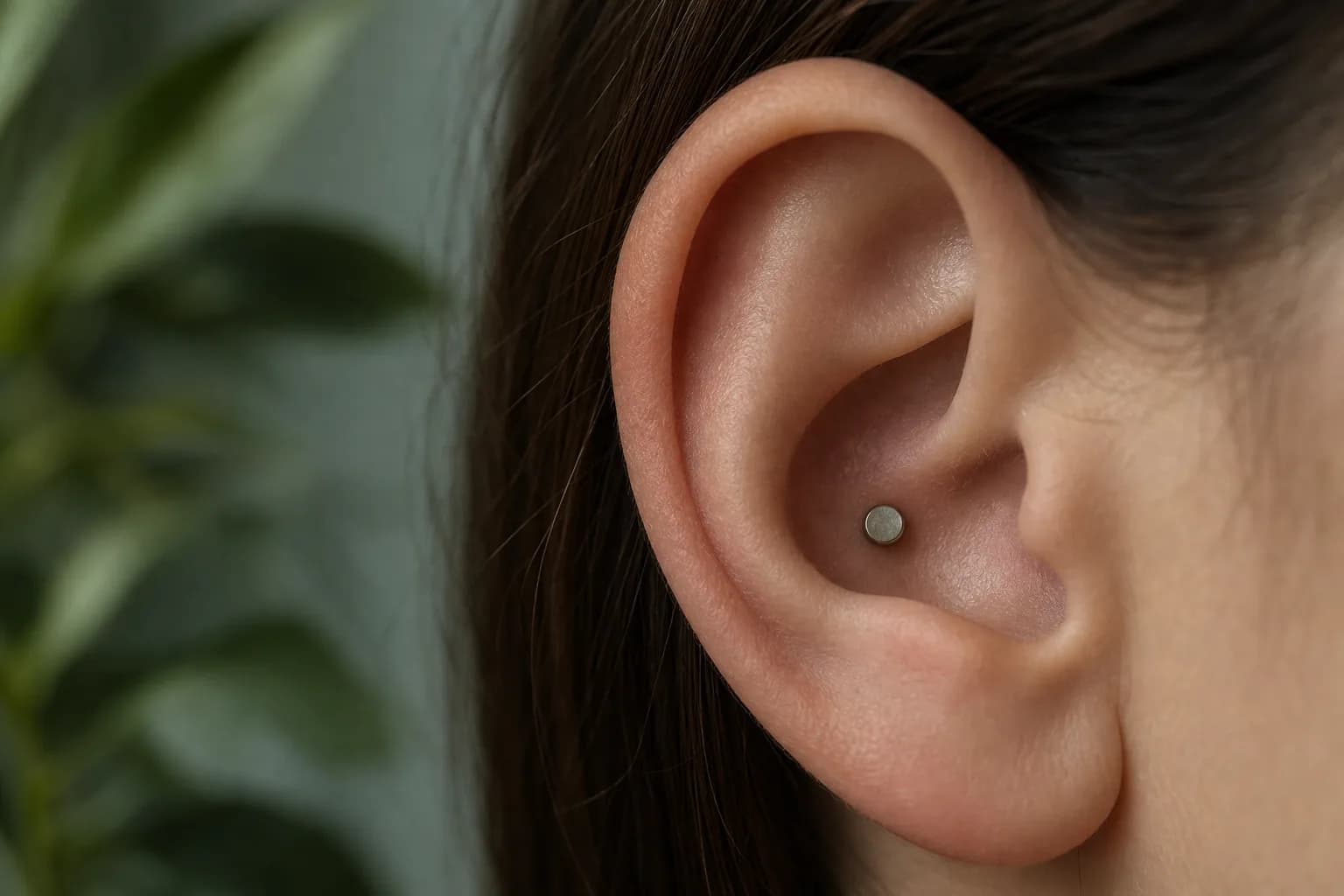
AI-generated illustration
Key takeaways
- Inner and outer conch placements refer to different locations within the ear’s cartilage.
- The Association of Professional Piercers lists conch healing as 6–9 months or longer.
- Initial jewelry needs suitable material, construction and anatomy-specific sizing.
- Professional downsizing can happen during healing; it is different from an elective jewelry change.
- Washington requires the shop license in reception and each practitioner’s license at their workstation.
A conch piercing passes through the cartilage in the ear’s inner cup, with inner and outer placements described by their position relative to nearby folds and ridges (Medical News Today). Choosing between them starts with a placement assessment, not just a jewelry photo.
Before booking, ask your piercer to explain the proposed position, initial jewelry, expected discomfort and follow-up plan. Also consider how you will keep pressure off that ear while sleeping—and distinguish a professional fit adjustment from a later change made only for appearance.
What is a conch piercing, and where are inner and outer placements?
Both placements pass through the ear’s inner-cup cartilage. Medical News Today describes the inner conch as parallel to the daith fold above the ear canal and the outer conch as closer to the antihelix ridge.
Use these landmarks to discuss the proposed position, then ask the piercer to show you exactly where the mark sits on your ear.
| Placement | Location and nearby landmark | Question to ask at marking |
|---|---|---|
| Inner conch | Parallel to the daith fold, above the ear canal | “Can you show me how this mark relates to the daith fold?” |
| Outer conch | Closer to the antihelix ridge | “Can you show me where this sits relative to the antihelix?” |
Ask whether a stud or ring’s dimensions suit your anatomy and placement. The Association of Professional Piercers (APP) says jewelry length or diameter must suit the wearer’s anatomy and placement (APP initial-jewelry guidance).
The useful consultation question is: “Which placement and jewelry dimensions suit this ear?” Bring a reference photo to explain the look you want, but ask the piercer to assess the placement rather than simply copy it. Our ear-piercing names and placement chart can help you identify neighboring placements before that conversation.
What should you ask about pain and healing time?
Plan for a substantial healing commitment. The Association of Professional Piercers’ 2013 procedure manual lists conch healing as 6–9 months or longer and explicitly says healing times cannot be guaranteed (APP procedure manual). Treat that estimate as a planning range, not a promised finish date.
For a broader comparison, the Center for Young Women’s Health lists 4 months to 1 year for ear cartilage and 6 weeks for earlobes (Center for Young Women’s Health). Its cartilage range is not a conch-specific guarantee and should not replace an individual follow-up assessment.
For the pain question, ask for an explanation rather than relying on a universal score:
- What discomfort should I expect during placement?
- What should I expect afterward?
- Which concerns should prompt a call to the studio, and which need a healthcare provider?
- Who can I contact if I have questions after leaving?
If you are deciding between a conch and another ear piercing, ask the piercer to discuss the actual proposed placements. A pain ranking alone does not answer the practical questions about jewelry, sleeping arrangements or follow-up.
Use our healing estimates by piercing placement to organize your planning questions.
What conch piercing jewelry should you discuss with your piercer?
Discuss conch piercing jewelry in terms of material, construction and fit before choosing its decorative appearance. Ask which designs are appropriate initially and which could be considered later.
Material
For initial jewelry, the APP identifies titanium meeting ASTM F136, ASTM F1295 or ISO 5832-3, or commercially pure titanium meeting ASTM F67, as suitable options (APP material standards). Ask for the material designation rather than stopping at the word “titanium.”
Construction
The APP’s standard includes internally threaded jewelry with a smooth skin-contacting post. Threadless, press-fit jewelry is an acceptable alternative; external threads can scrape tissue during insertion or removal (APP construction guidance). Ask the piercer to explain how the proposed jewelry connects.
Fit
According to the APP, jewelry that is too small increases the likelihood of swelling and embedding, while jewelry that is too large increases catching and trauma. That makes fit an anatomy-and-placement decision—not a universal conch measurement.
Ask why the selected length or diameter suits the proposed position.
Use this purchase checklist before agreeing to the jewelry:
| Check | APP standard or guidance | Practical question |
|---|---|---|
| Material designation | Titanium meeting the listed ASTM or ISO specifications | “Which specification does this piece meet?” |
| Construction | Internally threaded with a smooth post, or threadless press-fit | “How does this jewelry connect?” |
| Dimensions | Length or diameter suited to anatomy and placement | “Why is this size appropriate for my ear?” |
| Follow-up | Fit should remain part of the discussion | “How will you assess whether this fit needs changing?” |
If your preferred look is not the initial recommendation, ask what the piercer would need to assess before considering it later.
How should you clean a conch piercing and avoid sleeping pressure?
The APP recommends sterile saline labeled as wound wash, containing 0.9% sodium chloride without additives (APP aftercare guidance). Check the label with your piercer rather than choosing a product solely because it says “saline.”
Skip homemade salt recipes
The APP no longer recommends mixing homemade sea-salt solution because an overly concentrated mixture can dry the piercing and interfere with healing. If you encounter a homemade recipe, do not assume it matches the APP’s current recommendation.
Ask your piercer to show you the intended wound-wash product and explain how to use it in the written aftercare plan. If instructions conflict, ask the piercer to clarify; direct medical questions to a physician.
Arrange a pressure-free sleeping position
The APP warns that sleeping directly on healing cartilage can cause irritation and shifts in the piercing’s angle. It suggests positioning the ear in the opening of a travel pillow to avoid pressure (APP sleeping guidance).
Consider that setup before the appointment, especially if the proposed ear is the side you normally sleep on. Ask the piercer how to position your ear in the opening rather than resting the piercing against the pillow.
Before leaving the studio, check that you have:
- Identified the correct sterile wound-wash product and read its label.
- Planned a sleeping position that avoids pressure on the piercing.
- Received written cleaning and aftercare instructions.
- Confirmed whom to contact with aftercare questions.
Our piercing aftercare and infection-signs guide offers related questions to bring to your piercer or healthcare provider.
When can you downsize or change conch jewelry?
Professional downsizing is different from an elective cosmetic change. The APP says many piercings need downsizing before healing is complete, and a qualified piercer should perform downsizing and other jewelry changes during healing. Otherwise, suitable initial jewelry should remain throughout healing (APP jewelry-change guidance).
That distinction matters when booking follow-up. A fit-management appointment is an opportunity for the piercer to assess the current dimensions and decide whether downsizing is appropriate. It is not the same as deciding at home that it is time for a different-looking piece.
The APP’s conch healing estimate is not an automatic jewelry-change date. Nor should a wish to wear a ring replace a placement and fit assessment. Tell the piercer what style you eventually want, then ask how they will assess readiness for it.
Bring these questions to the appointment:
- Is the current jewelry fit suitable for my ear and placement?
- Is downsizing needed now?
- If a change is appropriate, which dimensions should the replacement have?
- When should you assess readiness for a different style?
Arrange any needed change with the piercer rather than using the appointment’s timing as a cue to change it yourself.
Which symptoms need medical attention?
Cleveland Clinic lists the signs of an infected ear piercing as discharge, fever, redness, warmth or swelling, and tenderness in the earlobe or cartilage. It advises calling a healthcare provider for chills or fever, an embedded earring, or redness, swelling and pain in the earlobe or cartilage (Cleveland Clinic).
Contact a healthcare provider about these symptoms rather than treating the concern only as a jewelry-fit issue.
When contacting the provider:
- Describe which symptoms you have and when you noticed them.
- Explain that the piercing passes through ear cartilage.
- Ask how promptly you should be assessed.
- Ask what to do about the jewelry while awaiting care.
Keep medical advice separate from a routine downsizing discussion. Ask the healthcare provider for instructions about treatment and jewelry.
What should you check before booking in Seattle?
Check both the location and practitioner licenses. Under Washington’s 2009 RCW 18.300.070, the shop’s location license must be posted in reception, while each practitioner’s individual license must be posted at their workstation (Washington State Legislature). These are separate checks.
King County had 47 active body piercer licenses and 172 licensed body art/tattoo shops in August 2026, according to WA DOL license data. Those are different license categories, not interchangeable measures of piercing availability. A shop listing alone is not a substitute for checking the practitioner who will perform the piercing.
Ask for the appointment details
Before booking, request answers to these questions:
- Placement: Will the piercer assess inner and outer conch options on my ear?
- Discomfort: What should I expect during placement and afterward?
- Jewelry: What material designation, construction and dimensions are proposed?
- Sterilization: How will the studio sterilize the jewelry used for my piercing?
- Aftercare: Will I receive written instructions and a contact for questions?
- Follow-up: How are fit checks and professional downsizing arranged?
Get a complete quote
Ask for the total and whether it includes the initial jewelry, follow-up appointments and any later downsizing. If a component is separate, request its cost before agreeing to the appointment. Our guide to published piercing prices in Seattle can help you organize that comparison without assuming every quote includes the same services.
Use the Seattle piercing directory and license checks to find a studio, then verify that it currently offers conch piercing and request a consultation. You can also read how the studio directory is assembled.
Bring your placement reference and your jewelry, sleeping and follow-up questions. Leave the consultation with a proposed placement, a clear quote and an aftercare plan you understand.
Frequently asked questions
Is a conch piercing more painful than a helix piercing?
Ask your piercer to discuss expected discomfort for each proposed placement and what to expect afterward. Use that conversation alongside the healing commitment and jewelry-fit assessment when deciding.
How long does a conch piercing take to heal?
The Association of Professional Piercers’ 2013 procedure manual lists 6–9 months or longer for conch healing. It also says healing times cannot be guaranteed.
Can I start with a hoop in my conch?
Ask your piercer whether a ring suits your anatomy and proposed placement as initial jewelry. The Association of Professional Piercers says jewelry length or diameter must fit the wearer’s anatomy and placement.
Can I change my conch jewelry before it has healed?
The Association of Professional Piercers says a qualified piercer should perform downsizing and other jewelry changes during healing. Suitable initial jewelry should otherwise stay in place throughout healing.
Can I sleep on a new conch piercing?
The Association of Professional Piercers warns that sleeping directly on healing cartilage can cause irritation and shifts in the piercing’s angle. It suggests positioning the ear in the opening of a travel pillow to avoid pressure.
How much does a conch piercing cost?
Request a quote from the studio for the proposed piercing and jewelry. Ask whether follow-up appointments and any later downsizing are included or charged separately.
Sources
- 1What to know about conch piercings — Medical News Today
- 2Jewelry for Initial Piercings — Association of Professional Piercers
- 3APP Procedure Manual: Piercing Healing Times — Association of Professional Piercers
- 4Body Piercing — Center for Young Women’s Health
- 5Suggested Aftercare for Body Piercings — Association of Professional Piercers
- 6Infected Ear Piercing — Cleveland Clinic
- 7RCW 18.300.070: Shop or business requirements — Washington State Legislature
- 8Washington State Department of Licensing - Professional License Counts (data.wa.gov) — Washington State Department of Licensing