Ear Piercing Chart: Names, Pain and Healing Times
Compare ear piercing names, pain and published healing ranges with an ear piercing chart, labeled diagram and Seattle consultation checklist.
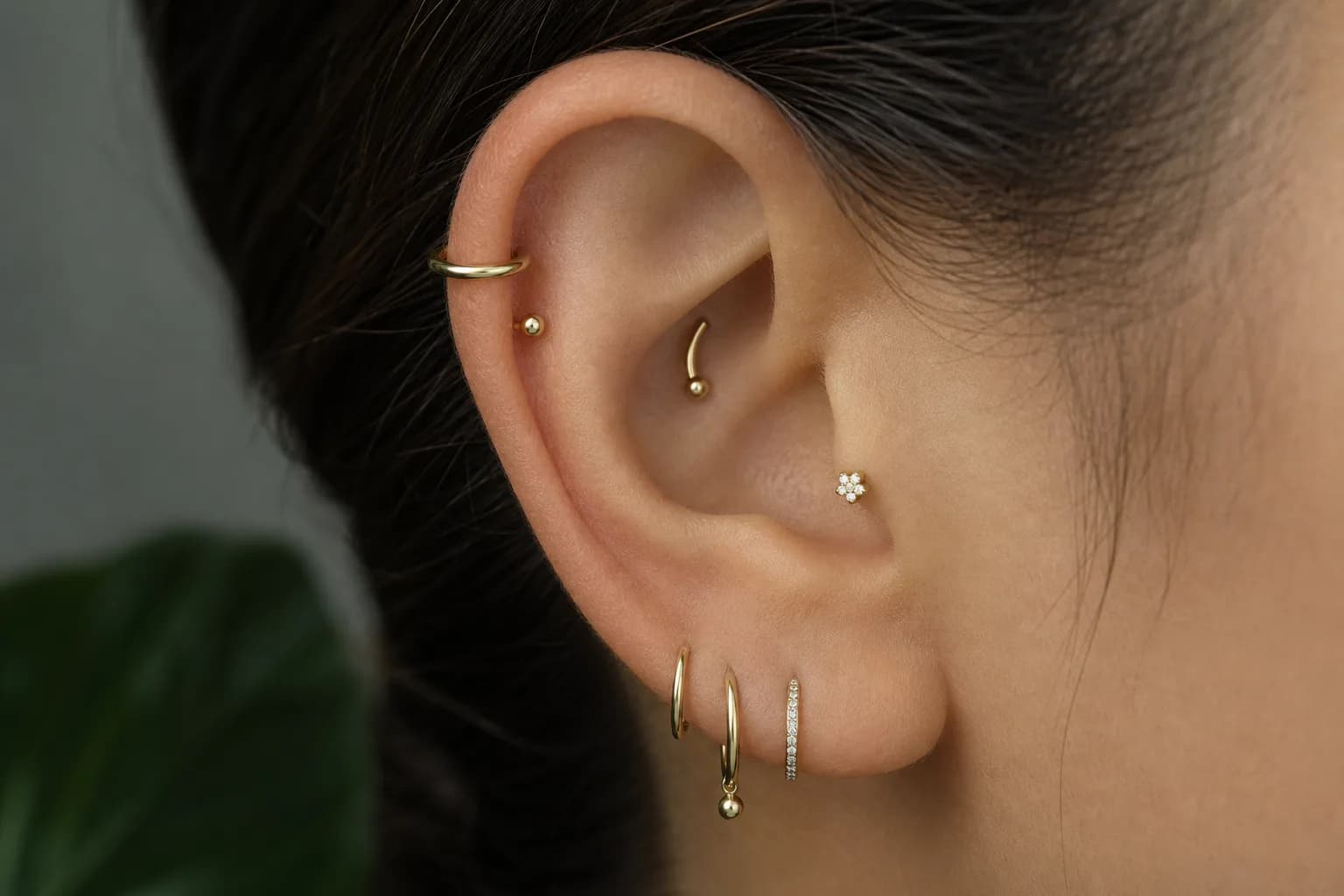
AI-generated illustration
Key takeaways
- The Association of Professional Piercers’ 2013 healing ranges are reference points, not guaranteed completion dates.
- Cleveland Clinic identifies earlobes as the least painful ear placement; pain also depends on method and personal tolerance.
- A piercer should assess anatomy and discuss jewelry, healing and aftercare before taking payment.
- The Association of Professional Piercers warns that sleeping directly on healing cartilage can cause irritation and angle changes.
- Washington’s body-piercing rules include an exception for qualifying earlobe stud-and-clasp systems.
An ear piercing chart helps you compare piercing names, placement checks and healing references before choosing an arrangement. The key is to match the name to the tissue your piercer actually proposes to pierce—not use the name alone to predict healing.
Start with the chart, then use the consultation questions below to discuss pain, jewelry fit, sleeping habits and follow-up with a Seattle piercer. A curated ear should be a plan built around your anatomy, not simply a collection of placements copied from a photo.
Where do the different ear piercings go?
Use this chart to identify the ear piercing names you want to discuss and the anatomy questions to ask. Its healing column gives published tissue-level references, not a personalized forecast.
For anatomical anchors, a January 2024 peer-reviewed paper identifies the rook at the inferior crus of the antihelix and the daith at the crus of the helix (Case Reports in Neurology). San Diego County’s June–July 2012 illustrated material labels the snug “anti-helix or snug” and depicts an industrial as a bar joining two upper-ear piercing points (San Diego County diagram).
Healing legend: The Association of Professional Piercers’ 2013 manual lists earlobes at 6–8 weeks or longer and ear cartilage, including conch, daith, rook and tragus, at 6–9 months or longer. Every range below refers to that dated publication, not a newly updated chart (APP 2013 procedures manual).
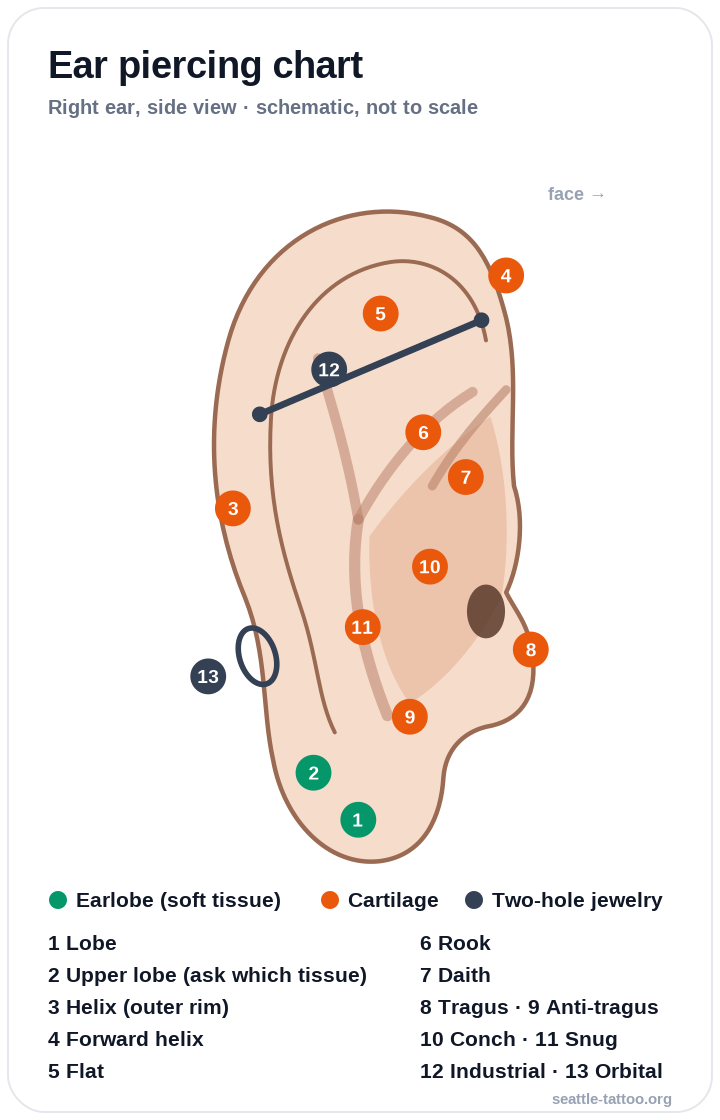
Schematic, not to scale: your piercer marks the exact spot for your anatomy. Placement references: Case Reports in Neurology, 2024 and San Diego County body art workshop, 2012.
| Piercing name | Anatomy or configuration check | APP 2013 healing reference |
|---|---|---|
| Lobe | Ask whether the proposed placement is in earlobe tissue | If earlobe: 6–8 weeks or longer |
| Upper lobe | Ask whether the proposed channel is entirely in earlobe tissue | If entirely earlobe: 6–8 weeks or longer; if cartilage: 6–9 months or longer |
| Helix | Have the piercer mark the location and confirm tissue | If cartilage: 6–9 months or longer |
| Forward helix | Have the piercer mark the location and confirm tissue | If cartilage: 6–9 months or longer |
| Flat | Have the piercer mark the location and confirm tissue | If cartilage: 6–9 months or longer |
| Conch | Have the piercer mark the proposed placement | 6–9 months or longer |
| Tragus | Have the piercer mark the proposed placement | 6–9 months or longer |
| Anti-tragus | Have the piercer mark the location and confirm tissue | If cartilage: 6–9 months or longer |
| Daith | Crus of the helix | 6–9 months or longer |
| Rook | Inferior crus of the antihelix | 6–9 months or longer |
| Snug | Labeled anti-helix or snug in the county diagram; confirm the proposed channel | If cartilage: 6–9 months or longer |
| Industrial | One bar joining two upper-ear piercing points | Where cartilage is pierced: 6–9 months or longer |
| Orbital | Ask the piercer to mark the configuration and identify the tissue involved | Earlobe: 6–8 weeks or longer; cartilage: 6–9 months or longer |
For an upper lobe piercing, make “Is this entirely earlobe tissue?” an explicit consultation question. For an orbital, ask the piercer to show the proposed configuration and explain which tissue reference applies. Neither name should replace an assessment of your ear.
How much do ear piercings hurt?
Ear piercing typically feels like a quick pinch followed by throbbing, according to Cleveland Clinic’s June 2025 guidance. It identifies earlobes as the least painful ear placement and says pain depends on placement, piercing method and personal tolerance (Cleveland Clinic).
That makes a placement-by-placement numerical pain score less useful than a conversation about the procedure you are considering. Someone else’s description cannot tell you exactly how a particular piercing will feel for you.
Before committing, ask:
- “Can you explain the procedure for this placement?”
- “What should I expect to feel during and immediately afterward?”
- “Can we discuss my concerns about pain before proceeding?”
If you are comparing different ear piercings, bring your shortlist rather than asking only which one hurts most. Ask the piercer to explain each proposed procedure so you can make a decision without relying on a universal pain ranking.
How should you read ear-piercing healing times?
Read the chart by tissue, not just by piercing name. Use the earlobe reference for an earlobe placement and the cartilage reference for a cartilage placement. Ask your piercer which tissue-based healing reference applies to the proposed placement.
Published references also differ. Separately from the APP’s 2013 manual, Kaiser Permanente’s reference, current as of February 3, 2026, lists 3–12 months for ear cartilage and 6–8 weeks for a category that includes earlobes (Kaiser Permanente). Keep those references separate rather than combining their endpoints into a new range.
A reference range is not a jewelry-change appointment
Appearance alone is not a completion test. APP explains that a piercing heals from the outside inward: the exterior may feel healed while the interior remains fragile (APP aftercare).
Use the published ranges to discuss the commitment involved, then ask your piercer for an individual healing assessment. Our piercing healing time chart compares more placements and sources side by side. A calendar reminder can prompt you to contact the studio, but it should not serve as automatic permission to change jewelry. Ask what the piercer will assess and how to arrange that review.
Which placements suit your anatomy and curated-ear plan?
A useful consultation starts with your ear, not a finished jewelry photo. APP says a prospective piercer should offer a consultation before taking payment to inspect anatomy and discuss jewelry, the procedure, risks, complications, healing and aftercare (APP choosing a piercer).
Bring reference images as a way to explain your preferences, then ask:
- “Can you mark this placement on my ear?”
- “Does my anatomy support this arrangement?”
- “What jewelry length or diameter fits me?”
- “How would you plan these placements across appointments?”
- “How would this arrangement fit my sleeping routine?”
There is a fit trade-off to discuss. APP says initial jewelry needs an appropriate length or diameter for the client’s anatomy. Jewelry that is too small can contribute to swelling or embedding; jewelry that is too large can catch and cause excessive trauma (APP initial jewelry guidance).
Sleeping habits belong in the same conversation. APP warns that sleeping directly on healing cartilage can cause irritation and shifts in its angle. It suggests positioning the ear in a travel pillow’s opening to avoid direct pressure (APP aftercare).
Treat a curated ear as a consultation plan, not a fixed menu. Ask the piercer to explain which parts of your preferred arrangement suit your anatomy and how they would sequence the work, rather than choosing a universal number of piercings per appointment.
When should jewelry be downsized or changed?
Downsizing means changing to a shorter post after initial swelling subsides, according to APP. It is a fit adjustment, not simply a switch to jewelry you prefer aesthetically (APP piercing FAQ).
Follow-up matters particularly when your plan includes a helix piercing. APP warns that missing downsizing can allow migration or an angle change, especially when the piercing is slept on.
Before leaving the appointment, ask:
- Who assesses the fit? Find out whom to contact for a review.
- When does the studio want to review it? Ask for a plan specific to the proposed placement and jewelry.
- How is a jewelry change arranged? Confirm whether you need an appointment and what the studio wants you to do beforehand.
- What if the fit concerns me before the review? Get clear contact instructions rather than waiting silently for a scheduled visit.
Keep the follow-up plan separate from your ideas for replacement jewelry. You can save the look you eventually want while asking the piercer when it is appropriate to consider that change.
Feeling comfortable is not the same as having readiness assessed. Use the outside-in healing explanation above as a reason to request a review, not as something you need to judge on your own.
Which symptoms need medical attention?
Seek urgent medical assessment if you suspect an infection. The NHS page reviewed April 18, 2023, lists these possible signs (NHS infected piercings):
- Swelling, pain or heat at the piercing site.
- Marked redness or darkening around it.
- Blood or pus coming from the piercing.
- Feeling hot, shivery or generally unwell.
These are reasons to contact a medical professional, not a checklist for diagnosing yourself. When seeking help, explain that you have a piercing and describe what has changed.
Following NHS advice, leave the jewelry in unless a doctor tells you to remove it. Do not make a jewelry-removal decision based only on how the site looks or on advice about a different person’s piercing.
Keep the distinction clear: a studio can discuss jewelry fit and follow-up, while suspected infection calls for urgent medical assessment rather than waiting for a routine studio appointment.
What should you check at a Washington piercing appointment?
Washington’s current posted piercing requirements, effective July 1, 2010, require licensed practitioners to use presterilized, single-use disposable needles on one client, then immediately discard them in a sharps container (WAC 246-145-050).
The same rule includes observable preparation requirements. Practitioners wearing new gloves must open each package containing a sterile instrument in the client’s presence. Jewelry must arrive presterilized or be sterilized on-site before the procedure (Washington sterile-instrument and jewelry requirements).
Ask the studio to explain that preparation before the procedure starts. You can ask which packages will be opened in front of you and how the jewelry has been sterilized.
Understand the earlobe-system exception
Washington’s current posted definition, amended effective July 1, 2010, excludes qualifying earlobe stud-and-clasp systems from its definition of body piercing when used according to manufacturer directions and applicable FDA requirements (WAC 246-145-010). This is a legal definition exception, not a comparison of methods’ safety.
Before booking:
- Confirm the practitioner’s license information.
- Ask how the studio handles sterile instruments and jewelry.
- Ask what preparation you should expect to observe.
- If booking for a minor, ask about the studio’s age policy, required identification, consent forms and adult-attendance paperwork.
Get those booking requirements directly from the studio so you know what to bring and who needs to attend.
How can you prepare for a Seattle piercing consultation?
Turn the chart into a short consultation plan:
- Save the chart and highlight the placements you want to discuss.
- Bring your anatomy questions, especially for an upper-lobe placement or orbital configuration.
- Explain your sleeping habits and ask how the arrangement would avoid direct pressure.
- Request a jewelry-fit plan, including how follow-up and possible downsizing will be assessed.
- Confirm current services and appointment policies directly with the studio before booking.
The Seattle piercing directory lists 16 Seattle places to get pierced, including 4 dedicated piercing studios. Use it as a starting point, and compare what studios publish in our guide to Seattle piercing prices. For a first earlobe piercing, read needle vs. gun ear piercing in Seattle too.
You can also review how our directory listings are collected. Before committing, ask the studio to turn your preferred piercing names into marked placements, appropriate jewelry choices and a clear follow-up plan.
Frequently asked questions
Which ear piercing hurts the most?
Pain depends on the placement, piercing method and personal tolerance, according to Cleveland Clinic. It identifies earlobes as the least painful ear placement; discuss your proposed placement and pain concerns with the piercer.
How long do ear piercings take to heal?
The Association of Professional Piercers’ 2013 manual lists earlobes at 6–8 weeks or longer and ear cartilage at 6–9 months or longer. These are reference ranges, not guaranteed completion dates.
When can I change my ear-piercing jewelry?
Ask your piercer to assess healing and fit before changing jewelry. The Association of Professional Piercers explains that the outside can feel healed while the inside remains fragile; a shorter-post adjustment after swelling subsides is a separate fit decision.
Why is downsizing a helix piercing important?
The Association of Professional Piercers defines downsizing as changing to a shorter post after initial swelling subsides. It warns that missing this step in a helix piercing can allow migration or an angle change, particularly when the piercing is slept on.
Can I get all my ear piercings in one session?
Ask the piercer to assess your proposed arrangement rather than choosing a session count from a chart. The Association of Professional Piercers recommends a consultation covering anatomy, jewelry, risks, healing and aftercare before payment.
What paperwork should I ask about for a client under 18?
Before booking, ask the studio about its age policy, required identification, consent forms and whether an adult must attend. Confirm those details directly with the studio for the proposed piercing.
Sources
- 1Migraine Symptoms Induced by an Auricular Piercing in a 27-Year-Old Female: A Case Report, Figure 1 — Case Reports in Neurology / S. Karger
- 2FHD–Body Art Industry Program Update, slide 17 — County of San Diego Department of Environmental Health
- 3APP Procedure Manual, “Piercing Healing Times,” p. 27 — Association of Professional Piercers
- 4Ear Piercing 101: Healing, Hurting, Cleaning and More — Cleveland Clinic
- 5Body Piercing Healing Times — Kaiser Permanente / WebMD Ignite
- 6Suggested Aftercare for Body Piercings — Association of Professional Piercers
- 7Picking Your Piercer — Association of Professional Piercers
- 8Jewelry for Initial Piercings — Association of Professional Piercers
- 9Piercing FAQ, “Why is it important to downsize a piercing?” — Association of Professional Piercers
- 10Infected Piercings — NHS
- 11WAC 246-145-050: Standard Universal Precautions — Washington State Legislature
- 12WAC 246-145-010: Definitions — Washington State Legislature