Helix Piercing: Pain, Healing Time, Cost and Jewelry
Considering a helix piercing? Compare placement, healing, jewelry, Seattle published prices, cleaning, sleeping and headphone considerations.
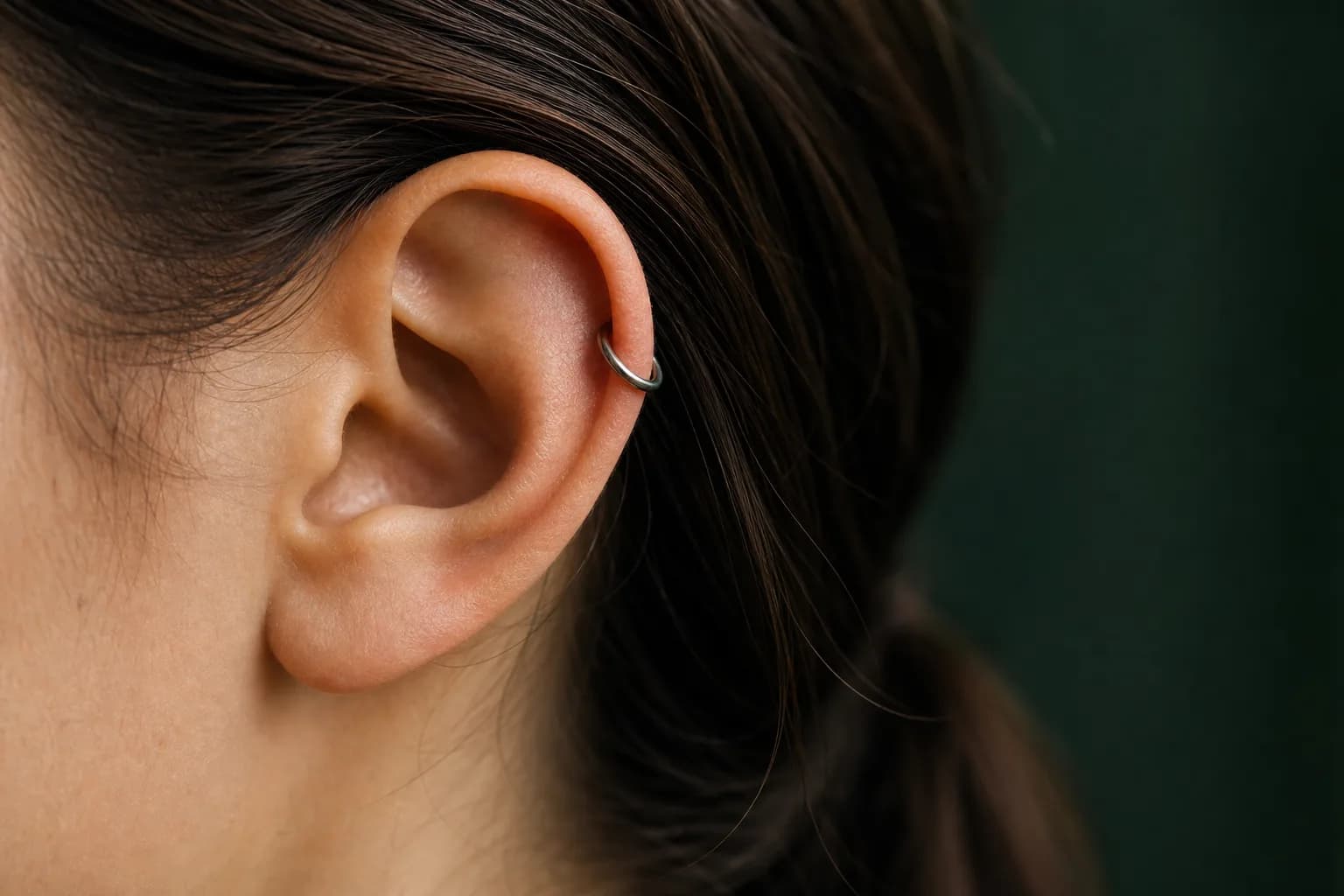
AI-generated illustration
Key takeaways
- Cleveland Clinic includes helix piercings in its six-to-12-month cartilage healing range.
- Seattle published examples include a $35 procedure fee plus jewelry and a separate $40 service-only fee.
- The Association of Professional Piercers recommends sterile saline wound wash containing 0.9% sodium chloride without additives.
- Sleeping directly on healing ear cartilage can irritate the piercing and change its angle, according to the Association of Professional Piercers.
- A published Seattle initial-jewelry option includes a titanium ring; suitability still needs an individual discussion with the piercer.
A helix piercing goes through the ear’s outer rim, so the first decision is where along that rim you want the jewelry to sit (County of San Diego placement diagram). Before booking, consider the whole plan: placement, initial jewelry, an itemized price and how you will manage everyday routines.
For Seattle readers, published prices make it possible to compare a procedure fee with a total that includes specific jewelry. Use those examples as a starting point, then ask the piercer to assess your ear and explain the proposed setup.
What is a helix piercing, and which placement do you want?
Helix
The helix is the outer rim of the ear. Bring a reference image to your consultation, but ask the piercer to mark the proposed position on your own ear before you decide. Check the mark from the front and side rather than relying on the placement name alone.
Forward helix
A forward helix sits at the front of the upper ear, near where it attaches to the head. The County of San Diego’s 2012 diagram distinguishes this location from the outer-rim helix.
For additional forward-helix placements, request a consultation rather than multiplying a single-piercing quote. A published Seattle listing explicitly covers a single forward helix and requires consultation for additional placements (published forward-helix listing).
Planning a double helix
If you want a double helix piercing, ask the piercer to mark the proposed arrangement and discuss whether it suits your ear. Explain whether you want the jewelry to look aligned, staggered or coordinated with existing pieces.
To distinguish these options from other ear locations, compare ear-piercing placements before your consultation.
Does a helix piercing hurt, and how long does it heal?
Expect some pain, and consider your individual tolerance before booking. Cleveland Clinic describes ear piercing as a quick pinch followed by throbbing and says cartilage piercings tend to hurt more than earlobe piercings. Placement, piercing method and individual tolerance affect the experience (Cleveland Clinic ear-piercing guidance).
Plan around a six-to-12-month healing range. Cleveland Clinic explicitly includes helix piercings in that cartilage-healing range (Cleveland Clinic healing guidance). Treat it as a planning range, not a promised completion date.
The practical question is whether you can accommodate the sleeping and device-care changes described below. Before booking, consider:
- Which ear you usually sleep on.
- Which headphones, earbuds and glasses you use regularly.
- How you will arrange professional follow-up.
Discuss individual healing questions with your piercer. If you are comparing a helix with another location, consult the healing ranges for other piercing placements.
How much does a helix piercing cost in Seattle?
Separate the procedure fee from the total with specified jewelry. These published examples, checked November 9, 2026, show different pricing formats—not a Seattle-wide average.
Seattle published price examples, checked November 9, 2026.
| Published option | Procedure/service fee | Published total with specified jewelry | Qualifications |
|---|---|---|---|
| Helix with titanium captive-bead ring | $35 plus jewelry | $65 plus tax | 16g ring; published Seattle price list |
| Helix with titanium barbell/disc-back and plain bead | $35 plus jewelry | $80 plus tax | 14g jewelry; same published price list |
| Single forward helix with titanium barbell and plain beads | $35 plus jewelry | $80 plus tax | 18g–16g; additional forward-helix piercings require consultation; published forward-helix price |
| Standard piercing listing that includes helix | $40 | Jewelry charged separately | Published Seattle service fee |
Compare like with like: a service-only figure is not the same as a jewelry-inclusive quote. The listed jewelry configurations are also specific options, not interchangeable descriptions of the same purchase.
When requesting a quote, ask for:
- The procedure charge for your proposed placement or arrangement.
- The exact jewelry item, material and size.
- Tax and the itemized total.
- Any separate charge for a later fit check, downsizing appointment or replacement post.
Do not assume follow-up jewelry or appointments are included unless the studio confirms that. For comparisons beyond helix placements, see published Seattle piercing prices.
Should you start with a stud or a hoop?
Ask the piercer to explain the proposed shape, fit and placement rather than assuming every helix must begin with a stud. The published Seattle titanium captive-bead-ring option above demonstrates a difference in initial-jewelry practice; it does not mean every hoop is appropriate for every ear.
Bring your preferred finished look to the consultation, then ask which jewelry the piercer proposes for the initial piercing and why.
Material specifications
For titanium, ask for the actual specification—not just the word “titanium.” The Association of Professional Piercers identifies implant-certified titanium meeting ASTM F136, ASTM F1295 or ISO 5832-3, or commercially pure titanium meeting ASTM F67 (APP initial-jewelry guidance).
If considering gold, APP’s conditions are 14k or higher, nickel- and cadmium-free, and alloyed for biocompatibility. APP warns that gold above 18k is too soft, and that gold-plated, gold-filled and vermeil pieces are not acceptable for fresh piercings (APP gold guidance).
How the jewelry connects
APP favors internally threaded jewelry: the post passing through the piercing is smooth, without exposed screw threads. It also recognizes threadless, press-fit jewelry as an alternative (APP jewelry construction guidance). Ask the piercer to show you how the proposed piece connects.
If your eventual goal is a hoop, ask how the piercer will assess that later change rather than setting a universal change date.
How do you clean a helix piercing?
Use the Association of Professional Piercers’ cleaning steps as the basis for your routine (APP aftercare):
- Wash your hands before cleaning or handling the piercing.
- Spray with packaged sterile saline wound wash containing 0.9% sodium chloride, without additives.
- Dry with clean disposable products.
APP recommends packaged sterile saline rather than homemade salt solution and advises against rotating the jewelry during cleaning.
Before leaving the studio, ask the piercer to walk through the instructions and identify an appropriate product. Check the label against the saline specification rather than choosing solely by a product’s name. Ask how to contact the studio if you are unsure about the cleaning steps later.
When to seek medical care: Mayo Clinic advises medical care when a cartilage piercing is painful, itchy, swollen and very red or dark. Seek medical care rather than applying home-treatment advice intended for minor soft-tissue piercing infections (Mayo Clinic cartilage-piercing advice).
Can you sleep on it or use earbuds and headphones?
Avoid sleeping directly on healing ear cartilage. APP says that pressure can irritate the piercing and change its angle. Its practical alternative is to place a travel pillow over your regular pillow and position your ear in the opening so there is no pressure on it (APP sleeping guidance).
Think through that arrangement before choosing which ear to pierce. If you habitually sleep on the proposed side, discuss how you will keep pressure off it rather than leaving the problem until bedtime.
Bring your audio setup into the consultation
APP recommends cleaning phones, headphones and eyeglasses with an appropriate disinfectant (APP device-cleanliness guidance). Ask about a suitable cleaning approach for the items you use.
Bring or describe your usual earbuds, over-ear headphones and glasses so the piercer can discuss how they relate to the proposed placement. Show where each item sits instead of assuming earbuds are automatically the better choice.
Ask for placement-specific advice about device use rather than relying on a universal waiting period.
How should you plan downsizing and jewelry changes?
Downsizing means having a piercer install a shorter post after initial swelling subsides. APP warns that an excessively long helix post can contribute to migration or angle changes, particularly when slept on. The piercer should perform the change because the piercing is not yet healed enough for self-changing (APP piercing FAQ).
Treat downsizing as a professional fit decision, not a do-it-yourself jewelry swap. It is also not proof that healing is complete.
Before leaving the initial appointment, ask:
- How do I arrange a fit check?
- How will you decide when a shorter post is appropriate?
- Is the appointment charged separately?
- Will I need to pay for a replacement post?
- How will you assess a future change to decorative jewelry or a hoop?
Keep the studio’s follow-up instructions with your aftercare information. Plan around the piercer’s assessment rather than a fixed downsizing week, and clarify whom to contact if you have questions about the jewelry’s fit.
What should you confirm before booking in Washington?
Start with a procedure-safety question. Washington’s current WAC 246-145-060, effective July 1, 2010, requires licensees to use a single-use, presterilized disposable needle on one client, immediately discard it in a sharps container and never reuse needles (Washington piercing equipment rule). Ask the studio to explain its procedure.
Seattle Tattoo’s Seattle piercing directory lists 16 places to get pierced, including 4 dedicated piercing studios. Directory counts alone do not confirm which listings offer helix appointments.
Published price examples include Evolve Seattle and Facet and Form. Contact any studio you are considering to confirm its services. You can also review how piercing directory listings are collected and verified.
Before committing to an appointment, confirm:
- Placement: the marked position and any proposed double or forward-helix arrangement.
- Jewelry: shape, material specification, construction and fit.
- Cost: the itemized total, tax and separate follow-up charges.
- Daily routines: sleeping position, audio devices and glasses.
- Care: cleaning instructions and professional follow-up arrangements.
Book once you understand both the initial setup and the plan for checking its fit afterward.
Frequently asked questions
Does a helix piercing hurt more than an earlobe piercing?
Cleveland Clinic says cartilage piercings tend to hurt more than earlobe piercings. It describes a quick pinch followed by throbbing, with pain varying by placement, method and individual tolerance.
How many months does a helix piercing take to heal?
Cleveland Clinic includes helix piercings in a six-to-12-month healing range for cartilage. Treat that as a planning range rather than a guaranteed healing date.
Does a quoted helix piercing price include jewelry?
Not necessarily. Seattle published examples include a $35 procedure fee plus jewelry and a $40 service fee with jewelry charged separately, so ask for an itemized total.
Can I sleep on the side with my new helix piercing?
The Association of Professional Piercers advises against sleeping directly on healing ear cartilage because it can irritate the piercing and change its angle. It suggests a travel pillow with the ear positioned in the opening.
When can I put a hoop in my helix?
Ask your piercer to assess the jewelry and timing rather than choosing a calendar date yourself. A published Seattle initial-piercing option includes a titanium captive-bead ring, so initial-jewelry practices are not universally stud-only.
Can I use homemade salt water to clean my helix?
The Association of Professional Piercers recommends packaged sterile saline wound wash containing 0.9% sodium chloride without additives rather than homemade salt solution. Its cleaning instructions also advise against rotating the jewelry.
Sources
- 1Body Art Workshop presentation, slide 17 — County of San Diego Department of Environmental Health
- 2Piercing Price List — Evolve Seattle
- 3Ear Piercing 101: Healing, Hurting, Cleaning and More — Cleveland Clinic
- 4Body Piercing Seattle — Menu of Alterations — Facet & Form
- 5Jewelry for Initial Piercings — Association of Professional Piercers
- 6Suggested Aftercare for Body Piercings — Association of Professional Piercers
- 7How to treat a piercing infection — Mayo Clinic
- 8Piercing FAQ — Why is it important to downsize a piercing? — Association of Professional Piercers
- 9WAC 246-145-060: Sterile procedures in body art, body piercing and tattooing — Washington State Legislature