Tragus Piercing: Pain, Healing and Jewelry
Considering a tragus piercing? Learn about healing, earbud use, jewelry, removal methods and Washington safety requirements.
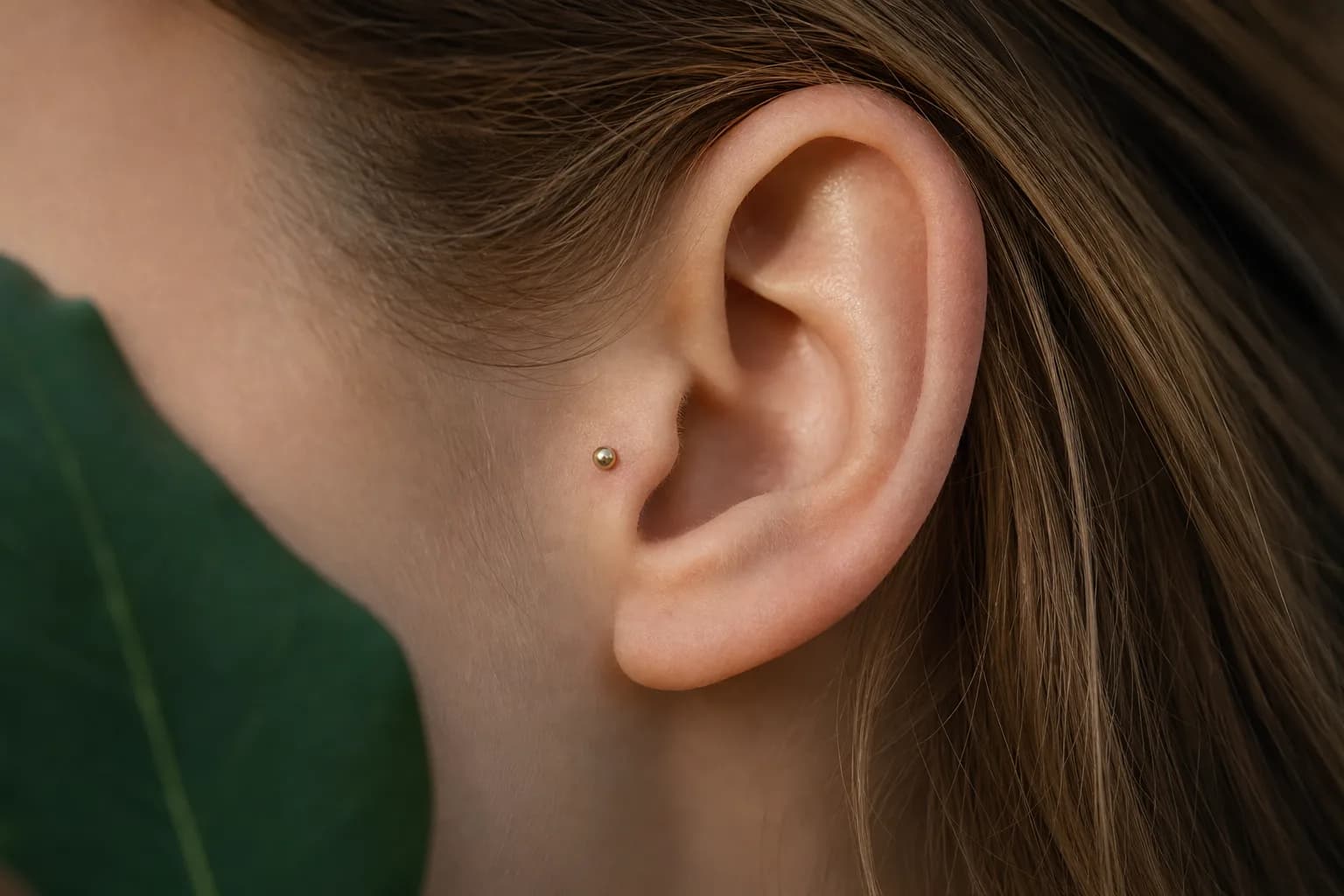
AI-generated illustration
Key takeaways
- The tragus sits beside the ear canal; the anti-tragus is a separate cartilage prominence above the earlobe.
- The Association of Professional Piercers’ 2013 manual estimates tragus healing at 6–9 months or longer.
- Dermatologist Arash Akhavan recommends avoiding earphones for at least four to eight weeks, ideally until completely healed.
- A qualified piercer may need to downsize jewelry before healing finishes.
- Washington requires presterilized single-use piercing needles and jewelry sterilized before the procedure.
A tragus piercing is worth considering if you can plan around earbud use, follow-up appointments and healing. Before booking, ask a qualified piercer to assess your anatomy and explain how the placement would work with your daily routine.
Keep several decisions separate: getting pierced, having jewelry professionally downsized, returning to earbuds and changing jewelry for style. Treating them as separate conversations will help you leave the appointment with a practical plan rather than a single date circled on the calendar.
Where is a tragus piercing, and how much does it hurt?
A tragus piercing passes through the small, triangular cartilage projection in front of and beside the ear canal, as described in StatPearls’ March 1, 2024 anatomy review. For broader orientation, compare it with other ear-piercing placements and names.
Does tragus piercing hurt? The available personal assessments suggest that you should expect some pain, but they cannot predict your experience. In Allure’s September 12, 2023 article, piercer Brian Keith Thompson estimated the pain at three or four out of 10; the article’s author rated their own experience at about five out of 10. These are personal assessments, not clinical measurements.
Tragus versus anti-tragus
An anti-tragus piercing is a different placement. The antitragus is a separate cartilage prominence above the earlobe and lateral to the tragus, with the intertragal notch separating them, according to StatPearls.
Do not apply the tragus pain assessments or healing estimate to an anti-tragus piercing. Ask for advice specific to the placement you are considering.
At the consultation, ask the piercer to:
- Identify the proposed placement on your ear.
- Assess whether your anatomy suits it.
- Discuss where your usual earbuds sit relative to that area.
- Explain what to expect during the procedure, rather than relying on someone else’s pain score.
How long does tragus piercing healing take?
The Association of Professional Piercers’ 2013 procedure manual estimates 6–9 months or longer for tragus piercing healing (APP procedure manual). Use that as a planning estimate, not a guaranteed completion date.
Healing and jewelry adjustment are not the same milestone. APP says many piercings require downsizing before healing finishes, and a qualified piercer should perform downsizes or other jewelry changes during healing (APP aftercare).
Earphone use has separate guidance. Dermatologist Arash Akhavan recommends avoiding earphones for at least the first four to eight weeks, ideally until the piercing is completely healed, in Allure’s September 12, 2023 article.
| Decision | Published guidance | Practical next step |
|---|---|---|
| Full tragus healing | APP’s 2013 manual: 6–9 months or longer | Plan for an extended healing period |
| Initial earphone avoidance | Allure’s interviewed dermatologist: at least four to eight weeks, ideally until completely healed | Discuss resuming your specific earbuds with your piercer |
| Professional downsizing | APP: may be needed before healing finishes | Have a qualified piercer assess and perform it |
| Elective jewelry change | APP: a qualified piercer should perform changes during healing | Ask about readiness before changing styles |
The initial earphone-avoidance period is not automatic clearance to resume use. Before leaving your appointment, ask when to return for assessment, how downsizing will be handled and whom to contact about jewelry changes. For comparisons with other placements, see our piercing healing-time chart.
Can you wear earbuds or use your phone while it heals?
Plan to avoid earphones initially, following the dermatologist’s recommendation above, ideally waiting until the tragus piercing is completely healed. Discuss AirPods or other earbuds with your piercer rather than treating the minimum waiting period as permission to wear them.
Device hygiene is a separate issue. APP says contact surfaces such as phones, headphones and eyeglasses can be cleaned with an appropriate disinfectant (APP ear and cartilage aftercare). That instruction applies to the device surfaces—not to applying disinfectant to the piercing.
A cleaned device and a device that is appropriate to wear against a healing piercing are different questions. Ask about both cleanliness and fit, including whether your usual phone position puts the device against the proposed placement.
Before the appointment, make a short list of the equipment you rely on:
- In-ear earbuds used for commuting, exercise or calls.
- A work headset or headphones.
- Your usual way of holding your phone during conversations.
- Eyeglasses that you want the piercer to consider.
Ask how to avoid contact with the placement and what device-use plan to follow during healing. If earbuds are essential to your workday, resolve that practical issue before booking rather than improvising afterward.
What jewelry should you discuss with your piercer?
Initial-jewelry materials
Ask for the material specification, not simply a “titanium” label. APP identifies titanium meeting ASTM F-136, ASTM F1295 or ISO 5832-3, and commercially pure titanium meeting ASTM F-67, as suitable options for initial piercing jewelry (APP initial-jewelry guidance).
For gold, APP specifies 14k or higher, nickel- and cadmium-free, and alloyed for biocompatibility. Its guidance also says gold above 18k is too soft, while gold-plated, gold-filled and vermeil jewelry are unacceptable for fresh piercings (APP gold requirements). A gold-colored appearance alone does not answer those material questions.
Ask the piercer to explain the proposed jewelry’s material, shape, fit and closure before the procedure. Keep those details with your aftercare instructions so you can refer to them at follow-up.
Downsizing versus switching styles
A downsize may be needed before healing finishes. An elective switch is a change you want for appearance. Do not treat the possibility of a necessary downsize as permission to change jewelry yourself during healing; APP assigns those changes to a qualified piercer.
If your eventual goal is a hoop, ask:
- Is this piercing ready for the change?
- Which shape and fit suit this placement?
- Who should perform the change?
Choose the initial jewelry with the healing plan in mind, then revisit style preferences at follow-up.
How should you clean it and avoid sleeping pressure?
APP recommends sterile saline labeled for wound washing, containing 0.9% sodium chloride with no additives. Its current aftercare webpage no longer recommends mixing homemade sea-salt solution (APP saline guidance). Check the product label rather than assuming every product called saline meets that description.
Sleeping arrangements also deserve attention. APP’s 2021 body-aftercare instructions warn that sleeping directly on healing cartilage can cause irritation and changes in the piercing’s angle. They suggest positioning the ear in a travel pillow’s opening to avoid direct pressure (APP body aftercare, 2021 edition).
Set up your routine before the appointment:
- Check the saline’s intended use, concentration and ingredients.
- Plan a sleeping arrangement that avoids direct pressure on the pierced ear.
- Ask the piercer to explain individualized cleaning instructions.
- Keep the studio’s contact information with those instructions for follow-up questions.
For a broader explanation of care routines and questions to raise at follow-up, see our piercing aftercare and cleaning guidance.
How do you remove tragus jewelry?
Start by identifying the closure rather than assuming every tragus stud unscrews. APP’s guidance for healed piercings distinguishes threaded jewelry from press-fit or threadless jewelry (APP healed-piercing guidance).
Threaded ends
APP explains that threaded ends loosen to the left. If the end will not unscrew, or you are unsure which part is intended to move, ask a qualified piercer to identify and handle it rather than continuing to twist an unknown mechanism.
Press-fit or threadless ends
Press-fit or threadless pieces pull apart rather than unscrewing. The mechanism is different, so the instruction to “unscrew the stud” does not apply to every piece of jewelry.
These closure descriptions are not a reason to attempt a change during healing. Ask a qualified piercer to perform healing-stage changes, including a necessary downsize. For future changes, ask the piercer to identify your closure and explain its operation when you are at the studio.
If removal is on your mind because of concerning symptoms, follow the medical-assessment guidance below instead of treating jewelry removal as a remedy.
Which symptoms need medical assessment?
Contact a physician or other healthcare provider about signs of possible infection. Cleveland Clinic lists the following symptoms associated with an infected cartilage piercing in its April 5, 2023 guidance:
- Fever.
- Discharge.
- Redness or warmth.
- Swelling or tenderness.
The clinic advises contacting a healthcare provider for signs of infection.
When contacting the healthcare provider, explain your symptoms and ask how to handle the jewelry. Do not substitute a jewelry change or removal appointment for medical assessment when infection is suspected.
APP says a qualified piercer should perform jewelry changes during healing, and its removal guidance distinguishes threaded from press-fit jewelry. A physician or other healthcare provider should assess suspected infection and advise you on medical care.
What should you check before booking in Seattle?
Washington’s WAC 246-145-050, effective July 1, 2010, requires presterilized, single-use disposable piercing needles, used on one client and immediately discarded into a sharps container (Washington piercing safety rules).
The same Washington rule, effective July 1, 2010, requires jewelry to arrive in presterilized manufacturer packaging or be sterilized on-site before the procedure (WAC 246-145-050). Ask the studio how it meets both requirements; our Washington body-art laws overview provides broader context.
Seattle Tattoo’s directory lists 16 places to get pierced in Seattle, including four dedicated piercing studios (Seattle piercing directory). Use the listings as a starting point for contacting locations and confirming current tragus-piercing availability. You can also read how our directory data is collected and verified.
Before committing to an appointment, work through this booking checklist:
- Placement: Request an anatomy assessment and confirm whether you mean tragus or anti-tragus.
- Daily routine: Discuss earbuds, headsets, phone use and sleeping arrangements.
- Jewelry: Confirm the material specification, proposed fit and closure.
- Follow-up: Ask how assessment and any necessary downsizing will be arranged.
- Needles: Confirm the presterilized, single-use needle and immediate sharps-disposal practices.
- Jewelry sterilization: Ask whether the jewelry arrives presterilized or is sterilized on-site.
Book when you understand both the procedure and the follow-up plan—and have a workable alternative to your usual earbuds.
Frequently asked questions
Does a tragus piercing hurt a lot?
In Allure’s interviews, piercer Brian Keith Thompson estimated pain at three or four out of 10, while the article’s author rated their own experience at about five out of 10. Your experience may differ from these personal assessments.
How many months should I plan for tragus healing?
Plan around the Association of Professional Piercers’ 2013 estimate of 6–9 months or longer. Ask your piercer to assess readiness before an elective jewelry change.
When can I use AirPods after a tragus piercing?
Dermatologist Arash Akhavan recommends avoiding earphones for at least four to eight weeks, ideally until the piercing is completely healed. Discuss your specific earbuds and readiness to resume them with your piercer.
Can I switch my tragus stud to a hoop before it heals?
Have a qualified piercer assess the proposed change. The Association of Professional Piercers recommends professional jewelry changes during healing, including necessary downsizing.
Why won't my tragus jewelry unscrew?
It may have a press-fit or threadless closure, whose pieces pull apart rather than unscrew. The Association of Professional Piercers says threaded ends loosen to the left; ask a qualified piercer for help if the closure is unclear or stuck.
What are the signs of an infected tragus piercing?
Cleveland Clinic lists fever, discharge, redness, warmth, swelling and tenderness among signs of an infected cartilage piercing. Contact a healthcare provider for assessment if you notice signs of infection.
Sources
- 1Ear Microtia — StatPearls/NCBI Bookshelf
- 2I Got a Tragus Piercing — Here's What You Should Know Before Getting One — Allure
- 3APP Procedure Manual, “Piercing Healing Times,” p. 27 — Association of Professional Piercers
- 4Suggested Aftercare for Body Piercings — Association of Professional Piercers
- 5Jewelry for Initial Piercings — Association of Professional Piercers
- 6Suggested Aftercare Guidelines for Body Piercings — Association of Professional Piercers
- 7Jewelry for Healed Piercings, “Jewelry Removal” — Association of Professional Piercers
- 8Infected Ear Piercing — Cleveland Clinic
- 9WAC 246-145-050: Standard universal precautions — Washington State Legislature