Industrial Piercing: Pain, Healing, Cost and Ear Fit
Is an industrial piercing right for your ear? Compare anatomy requirements, pain, healing, downsizing and published Seattle and Tacoma prices.
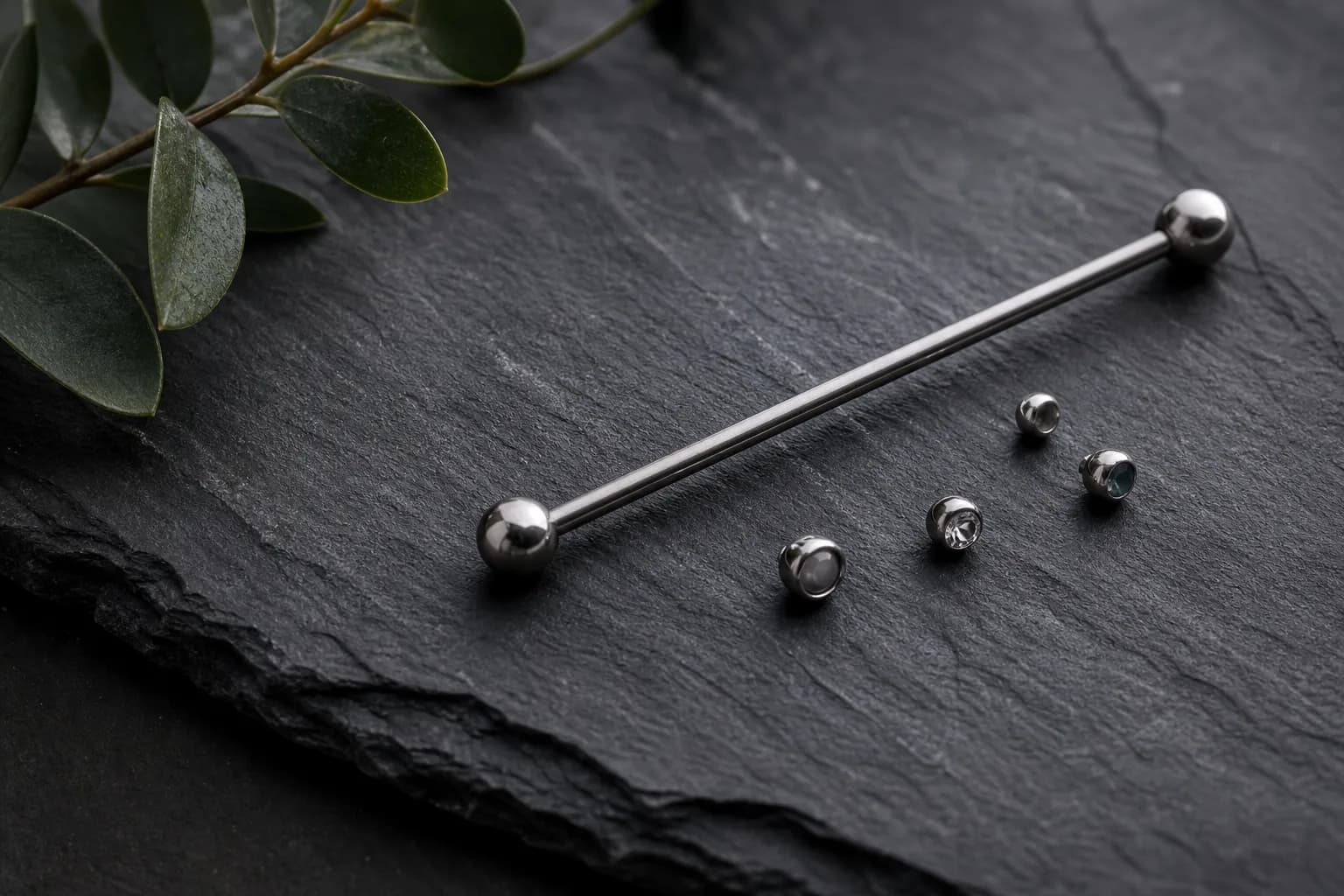
AI-generated illustration
Key takeaways
- A traditional industrial needs opposing outer-ear ridges and a clear path for the jewelry.
- Cleveland Clinic describes ear piercing generally as a quick pinch followed by throbbing, and says cartilage piercings tend to hurt more than earlobe piercings.
- Downsizing shortens the initial jewelry after swelling subsides; it does not mean the piercing is fully healed.
- Published Seattle and Tacoma prices include different combinations of procedure fees, jewelry, tax and aftercare.
An industrial piercing connects two piercing sites with one piece of jewelry, so a bump or snag at either end affects both sites (Lynn Loheide’s industrial explanation). Whether it suits you starts with ear fit—not just the look you want.
Before booking, ask for an anatomy assessment, an explanation of the procedure and an itemized quote. Also discuss how follow-up jewelry adjustments will work. For Seattle and Washington readers comparing options, the useful question is not simply what the appointment costs, but what the quoted price includes.
What is an industrial piercing, and will it fit your ear?
An industrial links two piercings with shared jewelry rather than treating each site as an independent placement. That connection matters when planning the piercing and managing everyday contact afterward: a disturbance at one end also affects the other.
What anatomy does a traditional industrial need?
Piercer Lynn Loheide explains that a traditional industrial needs sufficiently developed outer-ear ridges that face each other, with no intervening cartilage ridge obstructing the jewelry. Not every ear can safely support that configuration (industrial anatomy requirements).
An anatomy consultation should address the proposed jewelry path, not just whether there appears to be room for the piercing. Ask the piercer:
- Can these outer-ear ridges support the proposed placement?
- Do the ridges face each other appropriately for the connected jewelry?
- Is the jewelry’s path unobstructed by the cartilage between them?
- Can you explain why this placement does—or does not—suit my ear?
If a proposed plan involves separate jewelry before adding a connecting bar, ask the piercer to explain that approach and how it addresses your anatomy. Do not treat separate piercings as a do-it-yourself workaround or assume they can later be connected without assessment.
Use our guide to ear-piercing placement names to describe the look you mean. Bring a reference image to the consultation, but let the discussion focus on your ear rather than reproducing someone else’s exact placement.
How painful is an industrial piercing?
Cleveland Clinic’s June 16, 2025 overview says ear-piercing pain depends on placement, piercing method and individual tolerance. It describes ear piercing generally as a quick pinch followed by throbbing and says cartilage piercings tend to hurt more than earlobe piercings (Cleveland Clinic’s ear-piercing overview).
Someone else’s numerical pain rating describes their experience; it is not a measured prediction of yours. A more useful consultation question is, “What will happen during the procedure, and what should I expect at each stage?”
Separate the appointment experience from the commitment afterward. Because an industrial’s jewelry connects both sites, discuss how manageable everyday contact will be—not only whether you feel prepared for the piercing itself. Explain any concerns about pain before the appointment so the piercer can walk you through the process without promising a particular pain level.
What makes industrial healing demanding?
Piercer Lynn Loheide says an industrial can take up to a year to heal, and sometimes longer. Loheide also identifies helmets, over-ear headphones and some eyeglass arms as potential interference during healing (industrial healing and lifestyle considerations). Treat that timeline as a planning consideration, not a guaranteed finish date.
For broader context, see our healing-time comparisons by piercing placement. For an industrial, the practical question is whether your routine can accommodate connected jewelry throughout healing.
Review your daily routine before committing
Discuss these points with the piercer:
- Required helmets: Explain what you wear for work, transportation or recreation, and ask about contact with the proposed placement.
- Headphones: Discuss where your over-ear headphones sit and whether they touch the jewelry.
- Eyeglasses: Show the piercer how the arms sit against your ear.
- Sleep: Explain your usual sleeping position and ask how to avoid direct pressure.
These are not separate concerns for each piercing site: the shared jewelry connects disturbances at both ends.
Sleeping directly on healing cartilage can cause irritation and shift the piercing’s angle. The Association of Professional Piercers (APP) suggests positioning the ear in a travel pillow’s opening to avoid direct pressure (APP aftercare guidance).
Keep cleaning straightforward
The APP recommends sterile wound-wash saline containing 0.9% sodium chloride without additives. It no longer recommends homemade sea-salt mixtures because an overly concentrated solution can dry the piercing and interfere with healing (APP cleaning recommendations). Ask the piercer to review the product label and explain the cleaning routine before you leave.
Why does jewelry length matter during healing?
The right jewelry length can change as swelling changes. According to the APP, initial jewelry commonly needs extra room for swelling to help prevent embedding. After swelling subsides, excessive length can snag and move too much, causing irritation and renewed swelling (APP jewelry-fit guidance).
That makes jewelry fit a follow-up issue, not simply a choice made at the original appointment. Neither “longer is safer” nor “shorter looks better” is a useful rule for choosing the fit yourself.
Downsizing is not the same as a cosmetic change
The APP defines downsizing as replacing the initial jewelry with a shorter post after initial swelling subsides—not waiting until the piercing is completely healed (APP explanation of downsizing).
The APP says many piercings need downsizing before healing is complete and recommends that a qualified piercer perform jewelry changes during healing (APP guidance on changes during healing).
Ask these questions at the follow-up:
- Does the current length still suit the amount of swelling?
- Is excess movement or snagging a concern?
- Is downsizing appropriate now, or should the fit be reassessed later?
- When should I return for another fit check?
Ask for a plan based on your piercing rather than choosing a bar length or replacement date from someone else’s experience. When booking, also establish who handles those appointments and whether replacement jewelry carries an additional charge.
How much does an industrial piercing cost in Washington?
Published Washington offers have different inclusions, so compare itemized quotes rather than treating them as an interchangeable price range.
A published Seattle price list gives an industrial procedure fee of $65 plus jewelry, or $115 plus tax with a basic 14-gauge titanium barbell with plain beads. It also requires an industrial consultation (published Seattle price list).
A published Tacoma listing starts at $120, including both piercings, a basic implant-grade titanium barbell and a can of sterile saline. Industrials are excluded from that listing’s tiered-pricing offer (published Tacoma price list).
| Published option | Listed price | Included | Confirm before booking |
|---|---|---|---|
| Seattle procedure-only option | $65 plus jewelry | Industrial procedure | Jewelry selection, tax and aftercare |
| Seattle basic-jewelry option | $115 plus tax | Procedure and basic 14-gauge titanium barbell with plain beads | Aftercare and follow-up charges |
| Tacoma starting package | From $120 | Both piercings, basic implant-grade titanium barbell and a can of sterile saline | Tax and follow-up charges |
Before accepting a quote, confirm:
- The exact jewelry selected and its price.
- Tax and whether saline is included.
- Consultation arrangements and any associated charge.
- Whether follow-up appointments, downsizing or replacement jewelry cost extra.
Use our guide to published piercing prices in Seattle for additional price context, or find Tacoma piercing consultation options. Request a current quote for your proposed jewelry and appointment.
What should you do if your industrial still hurts?
For ongoing discomfort, ask a qualified piercer to assess jewelry length, movement, snagging, pressure and anatomy fit. Describe when the discomfort occurs and what touches the jewelry during your routine.
These are assessment topics, not a diagnosis. Excess length, sleep pressure and an unsuitable jewelry path are reasons to investigate fit and contact; they are not proof of what is causing your pain. Do not assume downsizing will resolve it.
When should you seek medical care?
Pain, redness and swelling in the upper outer ear can indicate perichondritis, an infection of the tissue covering ear cartilage. In its June 10, 2022 guidance, Cleveland Clinic advises prompt medical care because untreated infection can damage cartilage and cause permanent ear deformity (Cleveland Clinic on perichondritis).
Seek prompt medical care if pain is accompanied by redness and swelling in the upper outer ear. A piercer’s jewelry-fit assessment does not replace medical care.
What should you check before booking a consultation?
Make the consultation a decision point, not a commitment to proceed regardless of the assessment. Ask for clear answers before scheduling the piercing:
- Anatomy: Can your ear support the proposed connected jewelry without an obstructed path?
- Daily contact: How do required helmets, headphones, eyeglasses and sleep pressure affect the plan?
- Cost: What does the itemized quote include, and what might be charged separately?
- Follow-up: Who checks jewelry fit, how is reassessment arranged, and how are downsizing costs handled?
Check licensing and new-jewelry preparation
Washington’s current commercial body-piercing statute requires both an appropriately licensed individual practitioner and a licensed shop or business. A shop license alone does not satisfy the requirement (Washington body-piercing licensing law). See our guide to Washington body-art licensing requirements for additional context.
Washington’s licensing rules require jewelry inserted into a newly pierced area to be free of nicks, scratches and irregular surfaces and properly sterilized before use (Washington piercing rules). Ask how the studio prepares jewelry for a new piercing.
Seattle Tattoo’s directory lists 16 places to get pierced in Seattle, including 4 dedicated piercing studios (Seattle piercing directory). Use it to find consultation options, then check the practitioner’s and business’s licensing separately. Book once you understand the anatomy assessment, daily-care commitments, itemized cost and follow-up plan.
Frequently asked questions
Can every ear support an industrial piercing?
No. Piercer Lynn Loheide explains that a traditional industrial needs sufficiently developed outer-ear ridges that face each other, without intervening cartilage obstructing the jewelry. Ask a qualified piercer to assess your anatomy.
Is industrial piercing pain always severe?
There is no universal pain experience. Cleveland Clinic says ear-piercing pain varies with placement, method and individual tolerance, and cartilage piercings tend to hurt more than earlobe piercings.
Are industrial piercings hard to heal?
They can be demanding because the shared jewelry means a bump or snag at one end affects both sites. Piercer Lynn Loheide says healing can take up to a year or longer, and helmets, over-ear headphones and some eyeglass arms can interfere.
Does downsizing mean my piercing is healed?
No. The Association of Professional Piercers defines downsizing as shortening the initial jewelry after swelling subsides, and says many piercings need this before healing is complete. A qualified piercer should perform jewelry changes during healing.
Is jewelry included in an industrial piercing price?
It depends on the listing. A published Seattle option is $65 plus jewelry or $115 plus tax with a basic titanium barbell, while a published Tacoma package starts at $120 with both piercings, a basic titanium barbell and sterile saline. Confirm the inclusions and final total before booking.
Sources
- 1Industrial Piercings 101—A Look at These Popular Ear Piercings — Lynn Loheide
- 2New Ear Piercing: Healing and Aftercare — Cleveland Clinic
- 3Aftercare – Association of Professional Piercers — Association of Professional Piercers
- 4Piercing FAQ – Association of Professional Piercers — Association of Professional Piercers
- 5Piercing Price List – Evolve Seattle — Evolve Seattle
- 6Price List – Tacoma's Best Piercing — Tacoma’s Best Piercing
- 7Perichondritis: Symptoms, Causes & Treatment — Cleveland Clinic
- 8RCW 18.300.090: Shop or Business License and Individual License Required — Washington State Legislature
- 9Chapter 308-22 WAC — Washington State Legislature